The modem
Part one of The Web in Nine Objects. A US Robotics, a Macintosh, and a newsroom in Queluz.
w9.pt/pieces/the-modem/
Anyone who went online in the 1990s knows the sound. A dial tone, the beeps of the number, then a screech, a hiss and a long rush of static, like two fax machines arguing. If you have seen You’ve Got Mail, you have heard it. If you were there, you can hear it now.
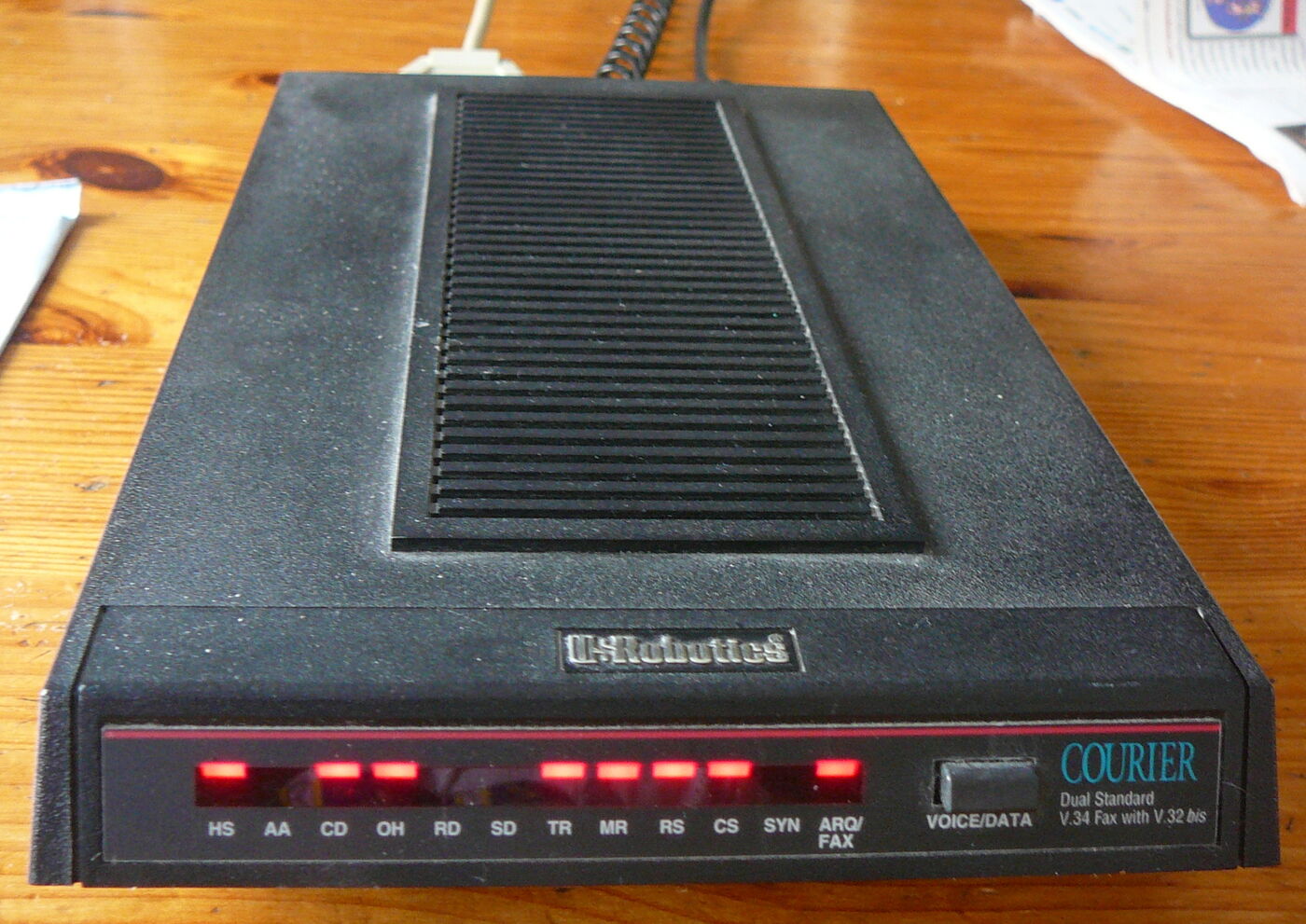
Mine first played in late 1994, in the newsroom of Nova Gente in Queluz. It came from a US Robotics 14.4k modem plugged into a Macintosh, and it was there for a story. I was writing an article about the Internet, and you cannot write about a place you have never been. The modem came first. The article could only be written with it.

A phone call to the rest of the world
A modem did something that still sounds a little absurd. The computer’s data went out as sound, over a telephone line built for voices, and a modem at the other end turned the sound back into data. The name says it: modulator, demodulator. The screech at the start was the two machines working out how fast they could talk to each other on that line, that day.
In Portugal the choice of who to call was short. Telepac was the first public provider. PUUG, the Portuguese UNIX users’ group, had started with the universities and later opened to the public too, so by 1995 you could call either. The article got me a free Telepac account, which I still count as one of the better perks of the job.
The article, “Internet: ‘Viaje’ pelo mundo”, ran in 1995. The recipe for getting online fits in one line: a personal computer (a 486 at least), a modem and a free phone line. Joining cost under 2,000 escudos, and the subscription was 2,500 escudos a month for fifteen hours. Telepac was getting about thirty requests a day and expected ten thousand Portuguese to be connected by the end of the year.
The first page I opened was most likely www.telepac.pt, and the www mattered. Type telepac.pt on its own and nothing came back; most sites were like that, because the name of the company and the name of its web server were not yet the same thing. One of the first places I went after that was whitehouse.gov. A newsroom in Queluz could read the White House directly, without a wire service in between.
At home
The calls were billed as local calls, so being online never came with a long-distance bill. In 1995, probably around March or April, I bought my own PC for home, a Pentium with a 28.8k modem, twice the speed of the one at work, and the screech moved into the house.
It was slow by any measure today. A page arrived line by line, images last, and a big file took forever: start the download, go and get a drink, come back and hope the line had held. It did not matter. Newsgroups, the Louvre’s paintings, mail that crossed the Atlantic in minutes, the White House: all of it came through a phone call.
In October 1996 I founded RogerLe.com in the US, and its site lived on a server at iServer.com. I looked after it from Portugal, over the same kind of call.
The silence
The last one I had was ISDN, 128k, which at the time felt super fast. Strictly it was not a modem at all. ISDN is digital end to end, two channels of 64k each, so there was nothing to modulate. It connected in a second, and it made no sound.
That is how the modem left: not replaced by something louder, but by something that did not need to announce itself. Every connection since has been silent, including the one this is written on.
Roger Morais, from the motorhome, October 2026. The series · All pieces